GNAT Architectural Diagrams
This page presents the system architecture of GNAT through a set of diagrams generated
with the diagrams Python library. The source scripts
live in docs/_diagrams/ and can be regenerated at any time:
python docs/_diagrams/generate_all.py
Diagram source files use Graphviz DOT format internally, making them compatible with Grafly for interactive editing.
System Overview
The following diagram shows all major layers of GNAT and how they relate to each other.
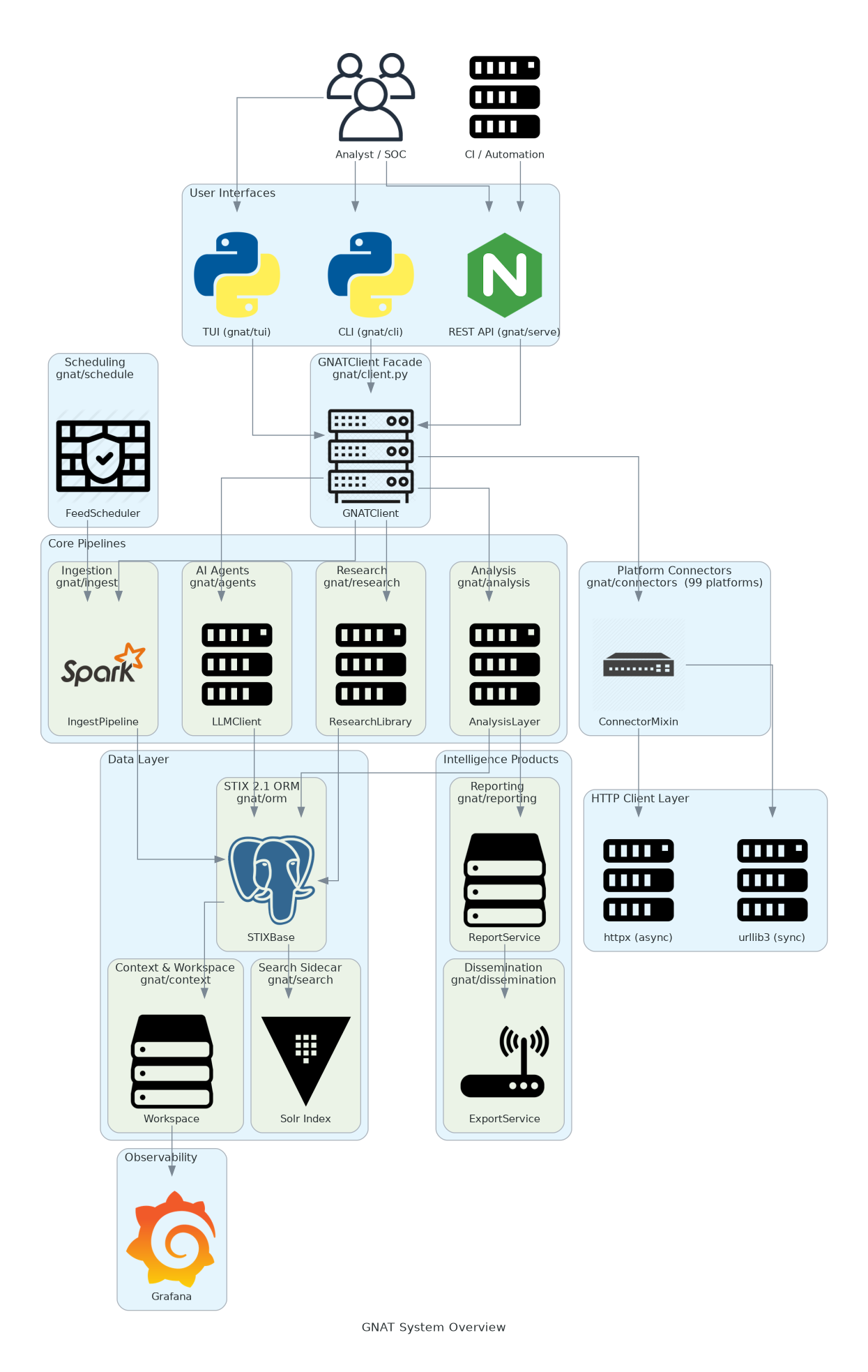
GNAT is structured as a layered architecture:
| Layer | Package | Responsibility |
|---|---|---|
| User Interfaces | gnat/cli/, gnat/tui/, gnat/serve/ |
CLI subcommands, Textual TUI, FastAPI REST + TAXII |
| GNATClient Façade | gnat/client.py |
Single entry point for all operations |
| Control & Safety (Phase 4) | gnat/core/ |
ExecutionContext, Domain boundaries, QueryBudget, trust enforcement |
| Core Pipelines | gnat/ingest/, gnat/analysis/, gnat/agents/, gnat/research/ |
Ingestion, analysis, AI, and research |
| Reasoning Layer (Phase 4C) | gnat/reasoning/ |
HypothesisEngine, ReasoningEngine, evidence scoring |
| Agent Governance (Phase 4D) | gnat/agents/governor.py, gnat/agents/hitl.py |
AgentGovernor, HITLGateway, XSOAR escalation |
| Intelligence Products | gnat/reporting/, gnat/dissemination/ |
Report lifecycle, export, webhooks |
| Data Layer | gnat/orm/, gnat/context/, gnat/search/ |
STIX ORM, workspace persistence, Solr search |
| Custom SDOs (Phase 4C) | gnat/stix/sdos/ |
STIXHypothesis, NegativeEvidenceRecord |
| Platform Connectors | gnat/connectors/ (159 platforms) |
Bidirectional integration with external platforms |
| HTTP Client Layer | gnat/clients/, gnat/async_client/ |
urllib3 (sync) + httpx (async) + budget tracking |
| Scheduling | gnat/schedule/ |
Cron-based feed scheduling |
| Testing Framework (Phase 4E) | gnat/testing/ |
SimulationConnector, ReplayRunner, AgentTestHarness |
→ Full narrative: docs/architecture.md
Phase 4 Control Layer
Phase 4 adds a control and safety layer that sits above all pipelines and connectors.
Every GNAT operation is now tagged with an ExecutionContext that carries its identity,
trust level, domain, and resource budget.
flowchart LR
    subgraph Control ["gnat/core/ — Control Layer"]
        CTX[ExecutionContext\ncontext_id, trust_level\ndomain, workspace_id]
        BDG[QueryBudget\nmax_units, consumed]
        DOM[Domain Boundary\n@domain_boundary decorator]
    end

    subgraph Reasoning ["gnat/reasoning/ — Reasoning Layer"]
        HE[HypothesisEngine\npropose → evaluate → close]
        RE[ReasoningEngine\nprioritize observables]
    end

    subgraph Gov ["gnat/agents/ — Governance"]
        AG[AgentGovernor\ncan_act, rate_limit, audit]
        HG[HITLGateway\nevaluate impact tier]
    end

    CTX --> BDG
    CTX --> DOM
    CTX --> HE
    CTX --> RE
    CTX --> AG
    AG --> HG
→ ADRs: 0039 · 0040 · 0041 · 0042 · 0043 · 0044 · 0045 · 0046 · 0047 · 0048 · 0049
Connector Architecture
The diagram below illustrates how the 159 platform connectors plug into GNAT via the
ConnectorMixin contract and the CLIENT_REGISTRY.
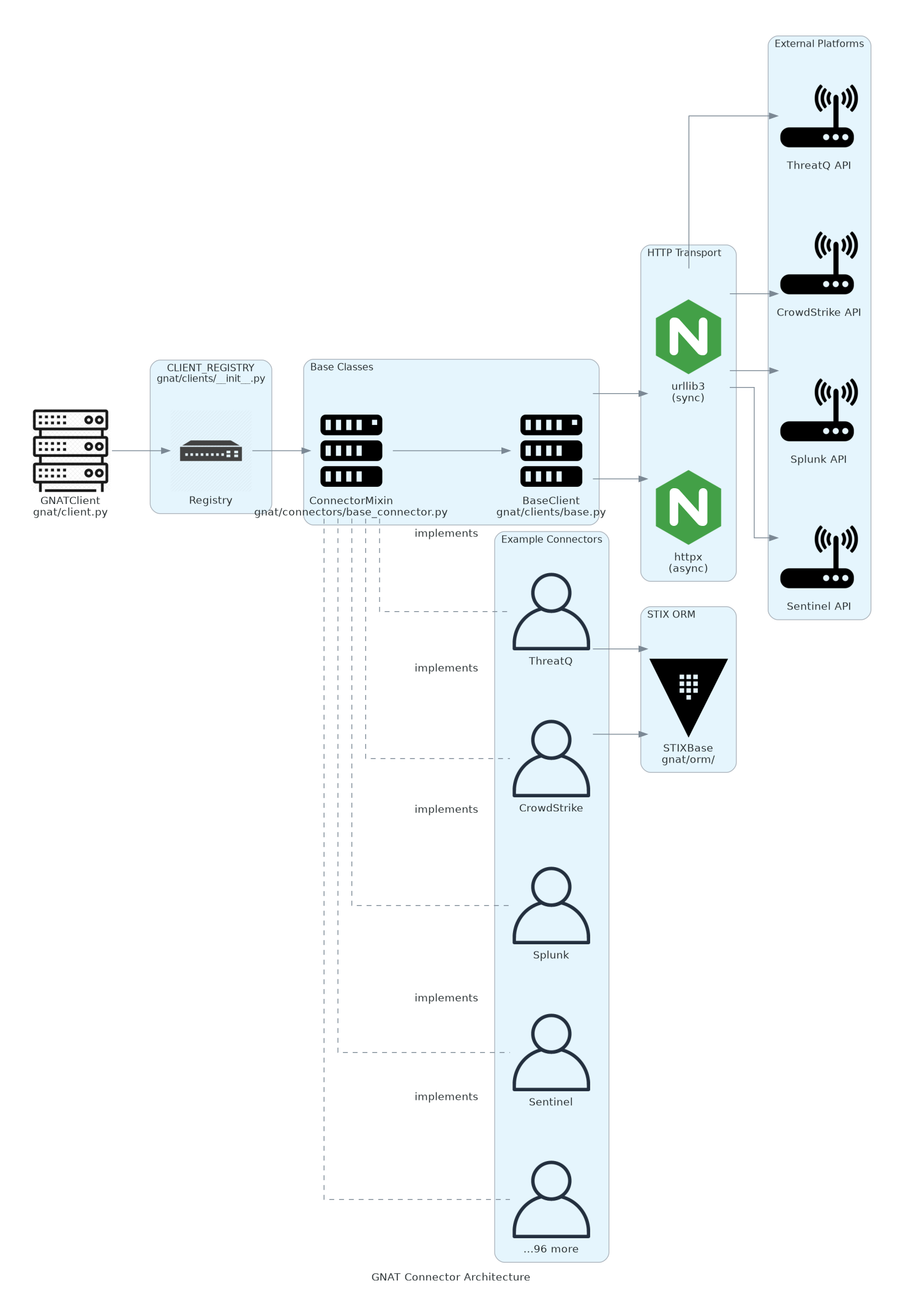
Key design decisions:
- All connectors subclass
ConnectorMixin(gnat/connectors/base_connector.py). - The
CLIENT_REGISTRY(gnat/clients/__init__.py) maps connector names to classes, allowingGNATClientto instantiate any connector by name from configuration. - Network I/O is always routed through
BaseClient(gnat/clients/base.py), ensuring uniform retry behaviour, error handling, and connection pooling. to_stix()/from_stix()methods on every connector provide bidirectional STIX 2.1 conversion.
→ ADR: 0003 — Connector Architecture
AI Agent Layer
The AI agent layer provides automated threat intelligence workflows powered by multiple LLM
backends through a single unified LLMClient façade.
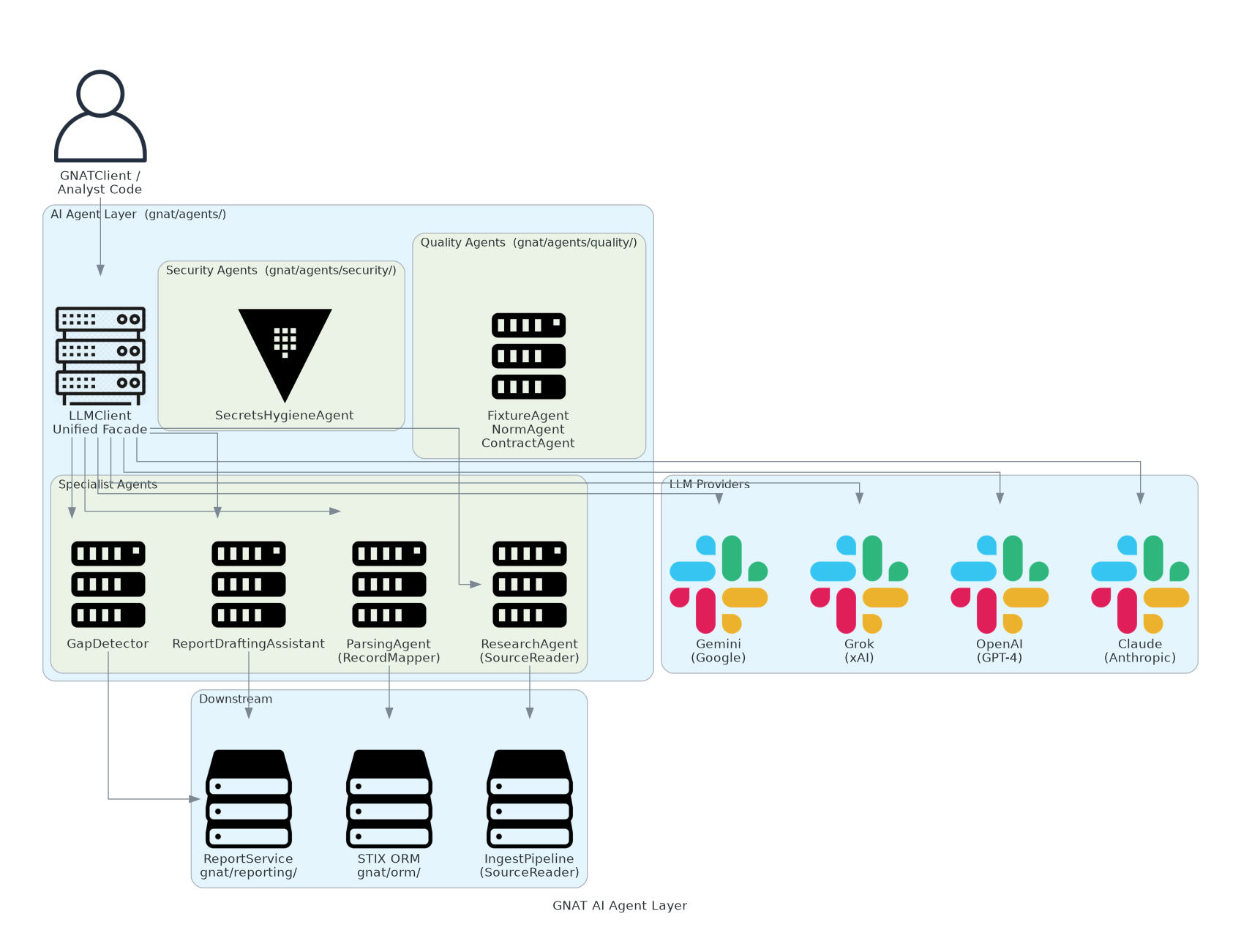
Component roles:
| Component | Role |
|---|---|
LLMClient |
Unified façade; selects provider; automatic fallback chain |
ClaudeProvider |
Anthropic Claude via urllib3 (no requests dependency) |
OpenAIProvider |
OpenAI GPT via urllib3 |
GrokProvider |
xAI Grok via urllib3 |
GeminiProvider |
Google Gemini via urllib3 |
ResearchAgent |
Plugs in as a SourceReader in the ingest pipeline |
ParsingAgent |
Plugs in as a RecordMapper; extracts STIX from unstructured text |
ReportDraftingAssistant |
Generates AI-backed executive summaries |
GapDetector |
Rule-based + LLM gap analysis on investigations |
→ ADR: 0018 — AI Agent Layer
Ingestion Pipeline
The ingestion pipeline reads threat intelligence from 14 source types, normalises records through 12 mappers, classifies IOCs, and writes STIX objects to the ORM.
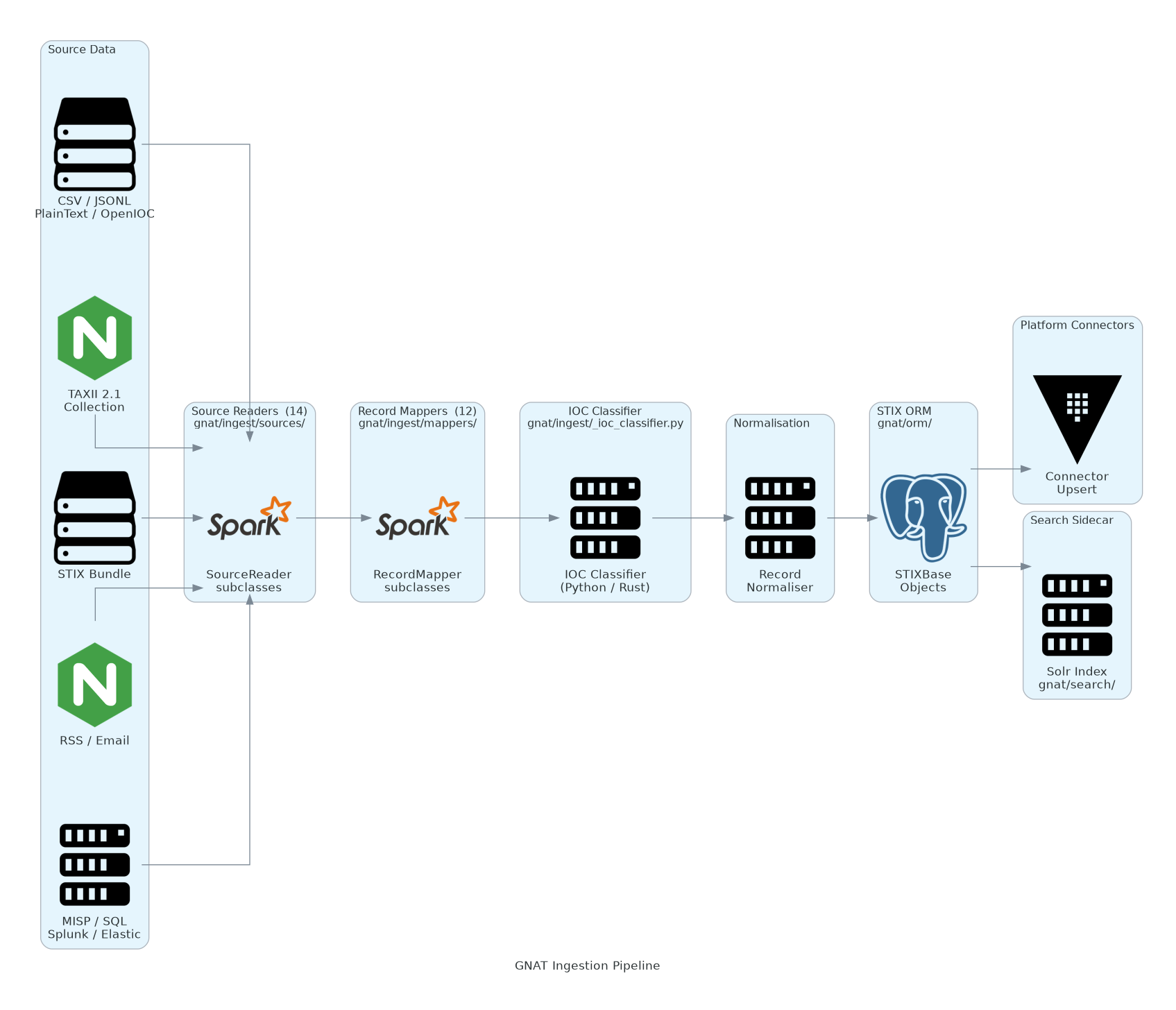
Pipeline stages:
- Source Reader — reads raw data (CSV, JSONL, STIX Bundle, TAXII, RSS, MISP, etc.)
- Record Mapper — transforms raw records into intermediate dicts (FlatIOC, STIXPassthrough, CEF, etc.)
- IOC Classifier — categorises IOCs by type (IP, domain, hash, URL, etc.); accelerated by optional Rust extension
gnat._core - Normaliser — resolves aliases, applies TLP, fills default fields
- STIX ORM — stores
STIXBaseobjects in the workspace - Connector Upsert — optionally pushes normalised objects back to platform connectors
- Search Sidecar — indexes objects in Solr for full-text search
→ ADR: 0004 — Ingestion Framework
Regenerating Diagrams
The PNG files in this directory are generated artefacts. To regenerate them after updating the source scripts:
# From the repo root
python docs/_diagrams/generate_all.py
Individual scripts can also be run directly:
python docs/_diagrams/generate_system_overview.py
python docs/_diagrams/generate_connector_arch.py
python docs/_diagrams/generate_ai_agents.py
python docs/_diagrams/generate_ingest_pipeline.py
Dependencies:
sudo apt-get install graphviz          # system dependency
pip install diagrams                   # Python package
Licensed under the Apache License, Version 2.0